Technical sheet
Read moreRead less- Location
- Bruges / Duffel
- Date
- 2018 - /
- Partner project Hoofding
- on the instructions of PongPing
- client
- professional
- Status
- Feasibility study finished without assignment
Expansie (Feasibility studies for SMEs)
Feasibility studies for SMEs exploring the possibilities for expansion on their own sites.
Companies are agile organisms. They have to be, in order to survive. They grow and shrink tactically. They develop side activities that sometimes become the core business. They adapt their processes and methods to do the same thing in a different way. The sites they occupy often bear witness to these movements. You can read them in building phases, adaptation works, zones of higher and lower intensity, and temporary fixes. The pride and DNA of the company are often embedded between the cracks. It’s a home base that shapes the business as much as the many lives unfolding within it.
That’s why relocating to a new site is often difficult and burdensome. Often, it’s also unnecessary if the current infrastructure is used more intelligently. The Expansion series focuses on carrying out such studies. These studies emphasise master planning and concrete architectural proposals that allow growth or transformation to happen on-site. Their implications are carefully mapped out: costs, the organisation of construction within an active business environment, phasing that follows growth, or adaptability in response to fast-changing work cultures.
CASE 1: Hoofding (for cliënt Aleris in Duffel)
Feasibility study for integrating an office function into an industrial hall, conceived as a large rack whose contents can change over time.
A large company has, among other things, a large hall. The hall is completely enclosed, you can’t look in or out, which is a pity, because there’s a lovely grove nearby.
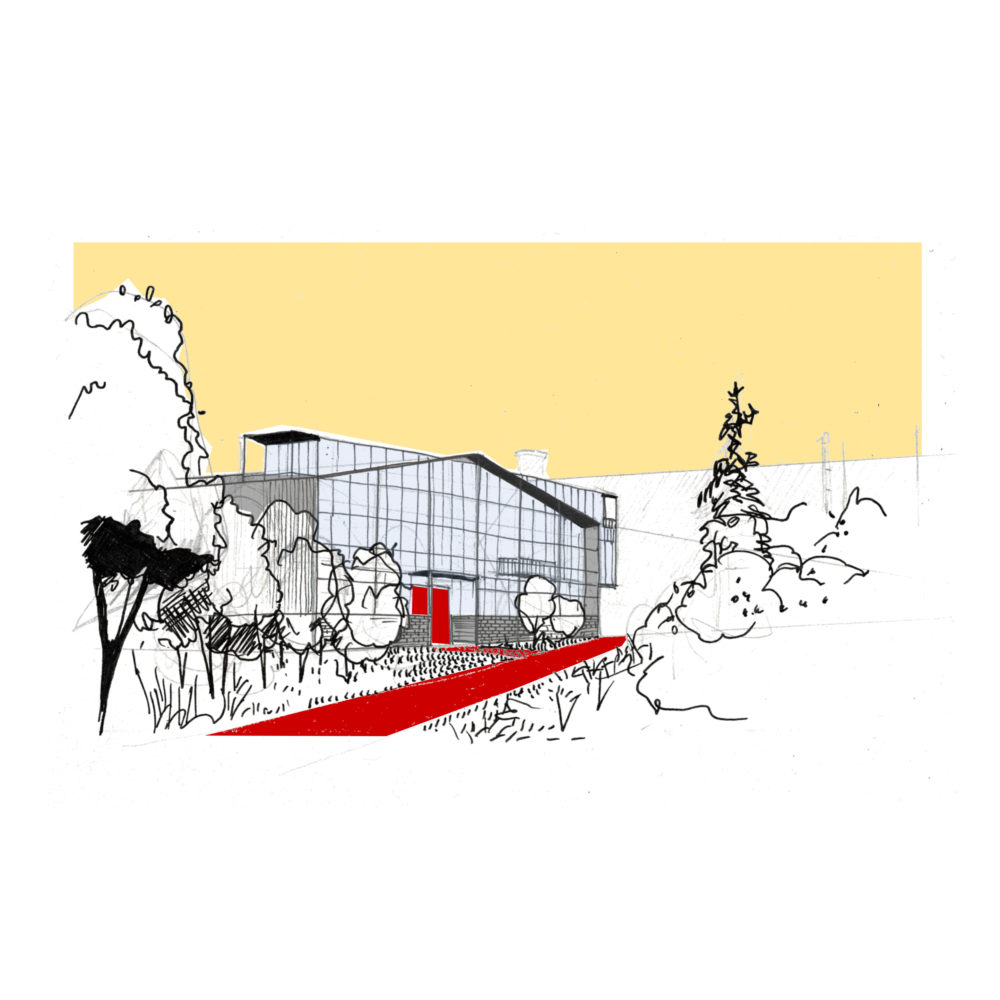
The company would like to be able to look into the hall, ideally through office spaces, preferably on the side façade. If you can also look out of the hall, that’s a bonus. Because of the forest’s proximity and the site's main access point, the idea emerges to design the building in such a way that it might one day serve as a visitor centre. In any case, the building should be a vertical slice, tall and slim, because bulky buildings no longer fit in this particular spot.
Even better than the side is the front: the head of the hall. Advantage: you get a deep view into the hall, and from within the hall an interesting focal point is created. A full stop at the end of a sentence. Advantage: you get sun and forest, both in the office building and from the hall.
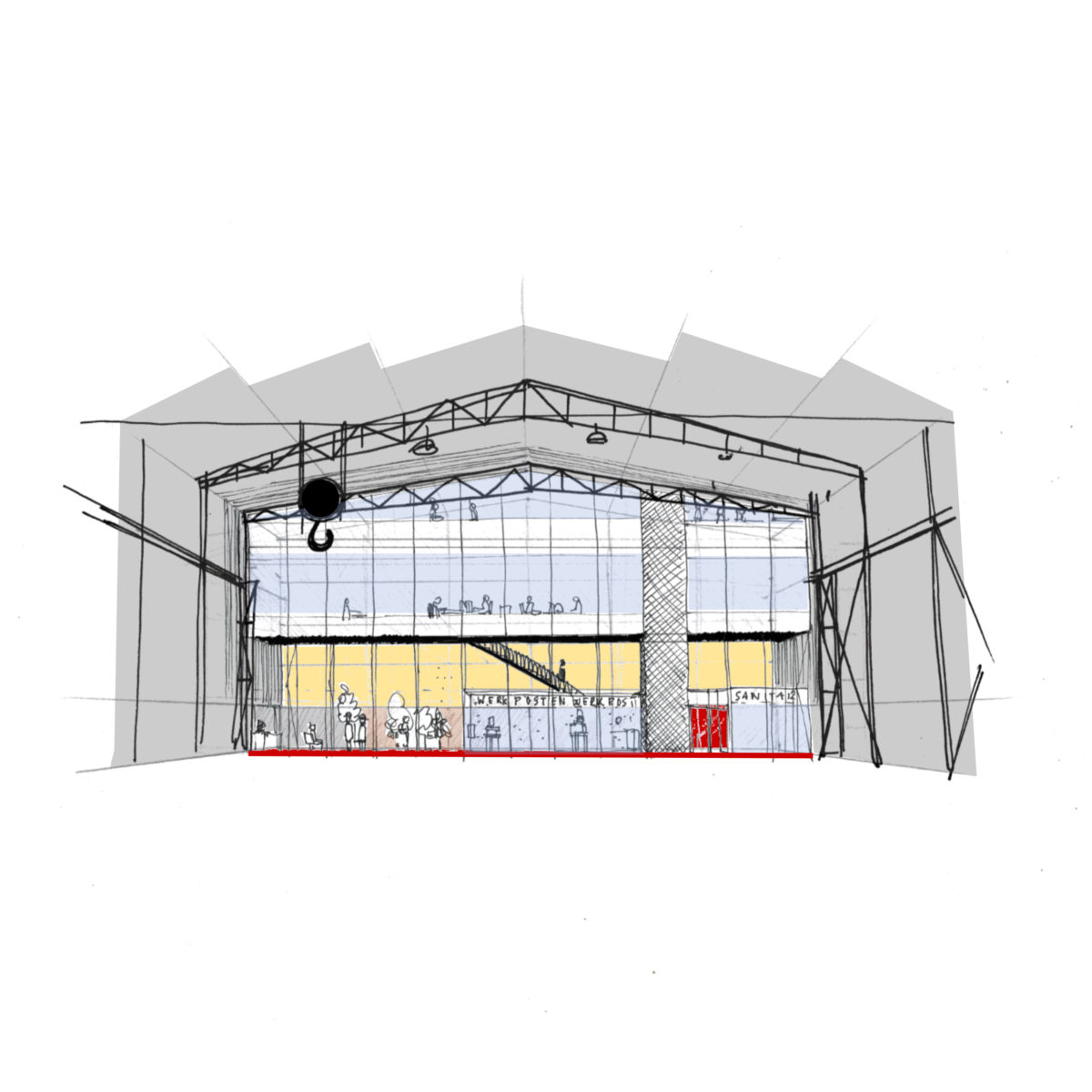
Advantage: the building, potentially a future visitor centre, is highly visible from the site's approach road, rather than being tucked around the corner. The building is not so much a building, but a very large rack that accommodates people. The rack sits inside the hall, not in front of it, so the forest and path can remain as undisturbed as possible. Like warehouse shelving, the rack’s structure is made to allow its contents to change. So now, there’s an object at the head of the hall: a title, a heading.
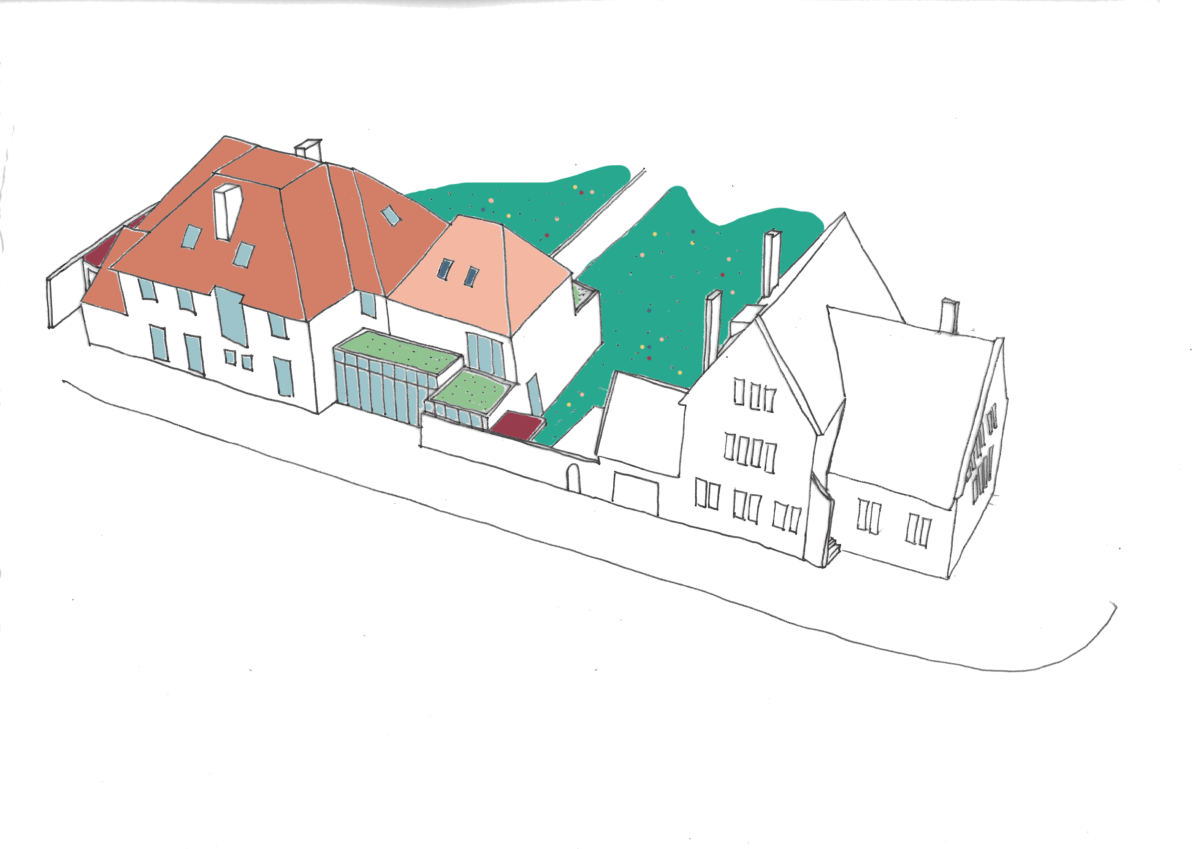
CASE 2: Ballon (for client Delbecque in Bruges)
Feasibility study for expanding substantial office space on a very limited footprint.
An office is facing a new growth challenge: either the company continues to grow on the site where it has been based for decades, or it must relocate entirely.
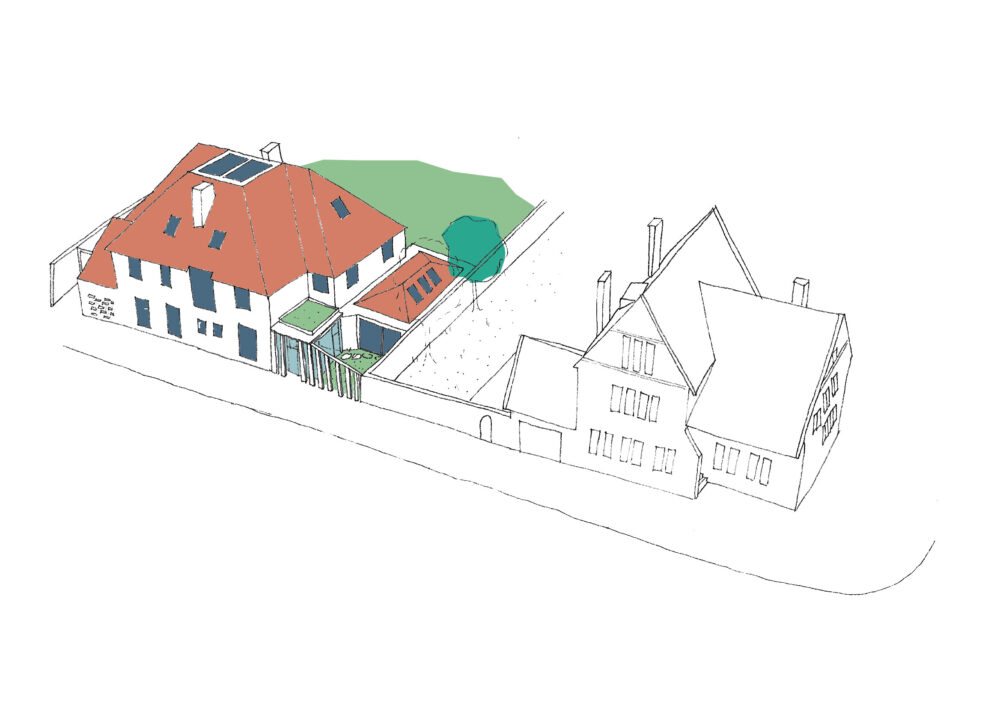
The site itself is already a complex patchwork. The main building is in fact two former homes, merged into one: a maze-like network of interlinked rooms. The residential function hasn't disappeared entirely either: nestled between the office spaces, there's still a private home overlooking a large garden. Next to this volume sits a spacious plot with a former rectory.
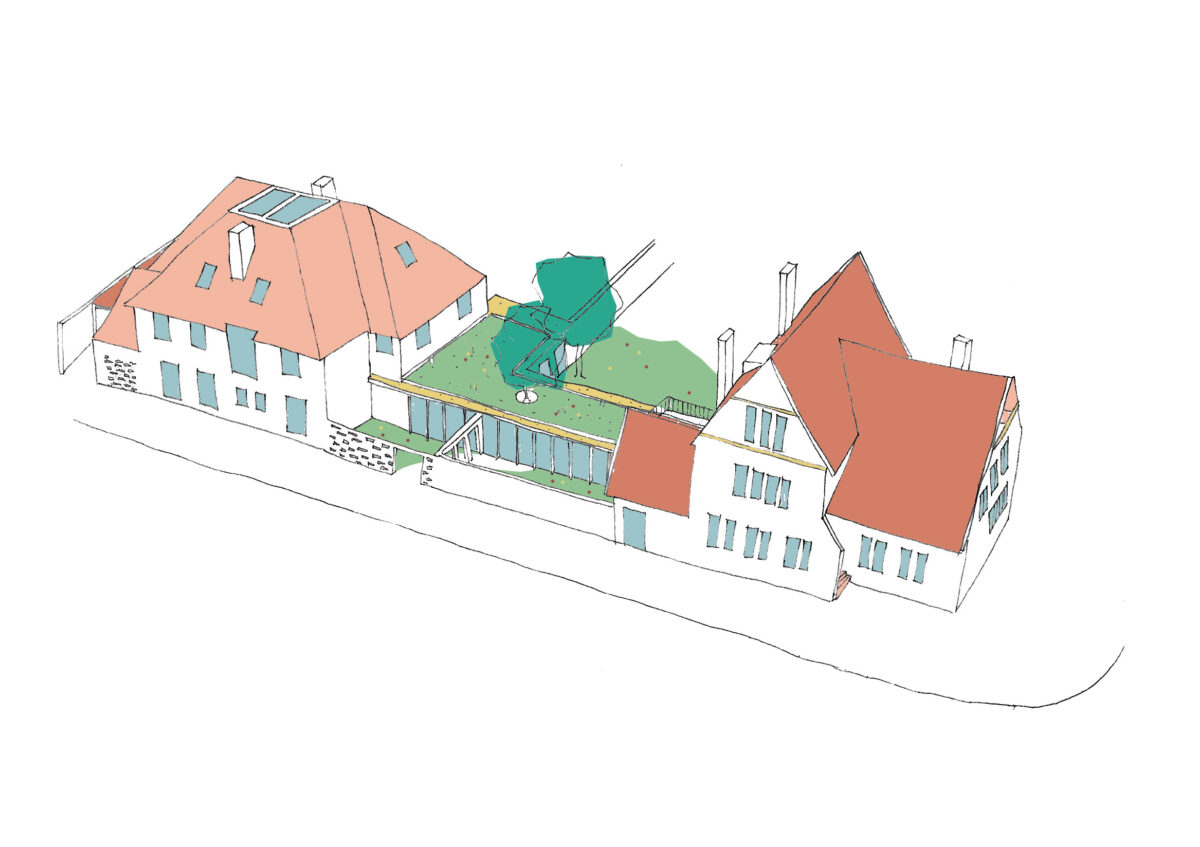
The study explores three different strategies. The first strategy focuses on realisation within the current plot boundaries. We push the limits and test whether these are viable. We examine whether this scenario aligns with the current needs, but also with possible future expansions that are still undefined. A second approach involves a partial acquisition of the neighbouring plot and a re-parcelling. This option allows more breathing space for expansion and enables a softer volumetric transition to the street. Part of the adjacent plot could also be converted into a green parking area, helping to balance out the pressure of a denser programme.
A third option considers acquiring the entire adjacent plot. This would immediately create 'too much' volume, but that surplus opens the door to desirable alternative uses such as renting out meeting rooms or small event spaces after office hours. With the possibility of a semi-public programme, careful thought must be given to access and address in order to avoid conflicts.
CASE 3: FRAMEWORK (for client In Hout in Nazareth)
Feasibility study for integrating circular and temporary offices into a warehouse
A construction company currently has its office and workshop on separate sites. To strengthen internal operations, team cohesion, and the clarity of its public image, the company wishes to explore whether office spaces can be integrated into the warehouse where the workshop is located.
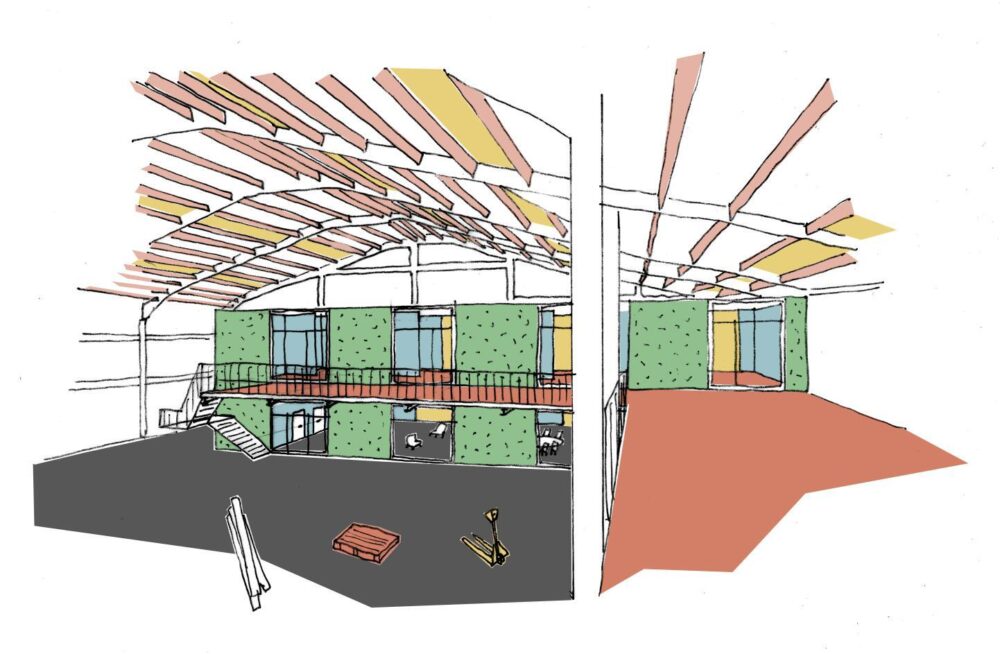
Integrated, because expansion isn’t an option. The offices would need to fit inside the warehouse, but ideally still offer views to the outside. Moreover, the entire concept must be demountable and relocatable. The warehouse is rented, and the contractor is a specialist in circular construction so the new offices must fully embody that DNA.
Not only are different spatial layouts compared, but several circular building systems are evaluated, and multiple options for creating new openings in the warehouse envelope are explored, all supported by parallel cost estimates that enable well-informed decisions.